COLD SPRING, NEW YORK
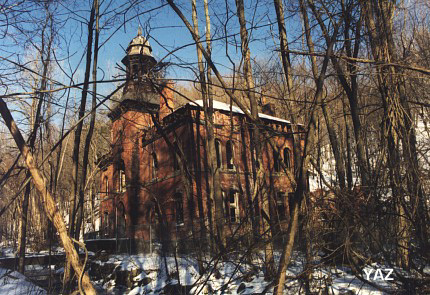
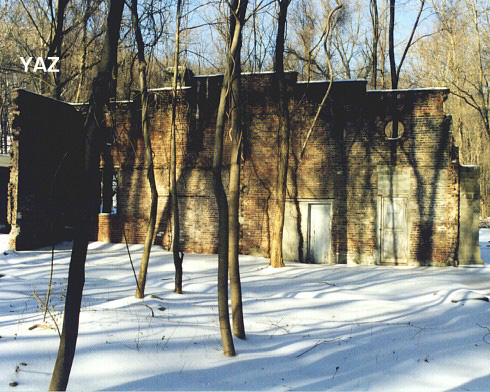
West Point Foundry Office, January 16, 1999
West Point Foundry Office, January 16, 1999
Just south of downtown Cold Spring is a placid wooded area that was once the site of the "deep breathing ... furnaces, and the sullen, monotonous pulsations of trip hammers"* of the well-known West Point Foundry. The foundry, which began operations in 1817 and continued through the 1880s (other industrial firms occupied the premises through the mid-20th century), was the "most extensive and complete of the iron works of the United States."* The site was chosen as one of four federally-subsidized foundry sites by President Madison in 1812 and the first director was Gouverneur Kemble, a resident of Cold Spring. Robert Parrot, also once a resident of Cold Spring, was a later director of the foundry.
The foundry in 1860 consisted of a "moulding house; a gun foundry; three
cupolas and three air furnaces; two boring mills; three blacksmiths' shops; a trip-hammer
weighing eight tons for heavy wrought-iron work; a turning shop; a boiler
shop; and several other buildings used for various purposes."* 500, and
sometimes 700 men were employed there during the 1860s, when the
"Parrot Gun" was manufactured in great quantities. The gun, actually a rifled
cannon, shot farther and more accurately than any other weapon at that time, and
is credited for helping the Union Army win the Civil War.
Quotations marked by "*" are taken from
The Hudson, from the Wilderness to the Sea, Benson J. Lossing. 1866.
Today the site
is accessed from the Cold Spring train station by following the gravel path the borders
the wildlife sanctuary east to the foundry. From the cove looking south
can be seen the famous and restored Dick's Castle. The first building at the Foundry you will
see is standing next to some great shelter, of unknown purpose to me. Only
the walls of this low brick building remain. According to the Beer's Atlas
of 1867, this was the site of the Carpenter Shop. It is hard to visualize,
but almost the entire wooded area here was covered by the various structures
of the Foundry.
Just a short distance in, one comes upon a solitary brick
wall, which still has its doors, next to a small building currently being used
by a boat-making organization, and the Office building of the West Point
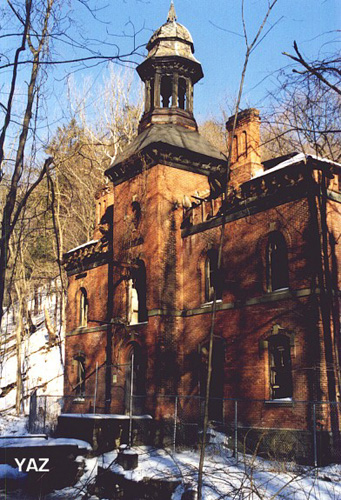
Foundry. This building
dates from 1865 and is the only structure on the site that still has its
roof. The office is a two-story brick building, with a central tower topped by a
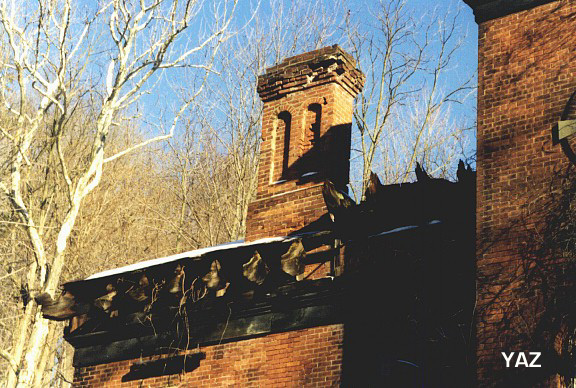
cupola. (The cupola has since been removed and is located near the office.) There is an addition in the rear that has lost its
roof;
only the walls survive. Architects in the office of Stephen Tilly (Dobbs Ferry, NY) prepared
stabilization drawings for the 1865 Office building in 2003 and Scenic
Hudson hired Kronenberger and Sons Restoration (Connecticut) to perform
the stabilization work. Scenic Hudson will also restore and reinstall the cupola
At the top of
the stony ravine is the mansion built by Hudson River
School artist
Thomas Rossiter in the 1860's. The house is still a private residence,
but directly south of it is Boscobel Restoration, which
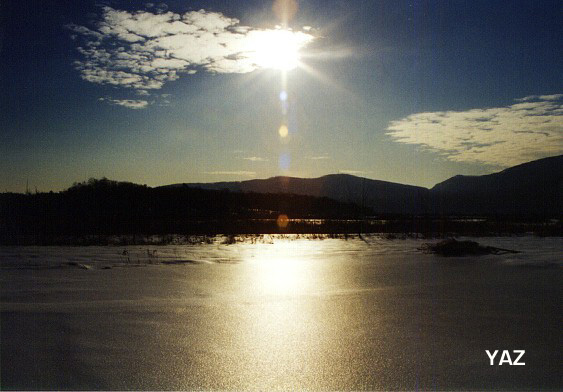
offers fabulous views of Constitution Marsh.
There is a marked
trail on the Foundry site. Stone walls and abutments of the buildings
and railroad spur and various foundations can still be seen. The site is owned by Scenic
Hudson, and is open to the public. However, since the foundry is an active
archaeological site, visitors are asked to tread carefully, stay on the trail,
and to not disturb or remove any features. Michigan Technological University has
been conducting a series of excavations and studies of the ruins, and
plans may develop for the restoration of the Office. I volunteered three days in
each of the 2007 and 2008 field school seasons; the field reports can be read here
and here.
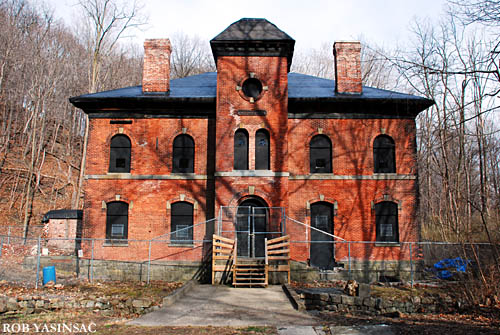
West Point Foundry Office, April 14,
2007.
MORE WEST POINT FOUNDRY PHOTOGRAPHS:
JULY, 2008
JANUARY,
2015
|
LINKS: Michigan Technological University Industrial Archaeology Program |
This page copyright © 2008 by Robert J. Yasinsac.
These
images cannot
be copied or reproduced without permission from Robert Yasinsac.