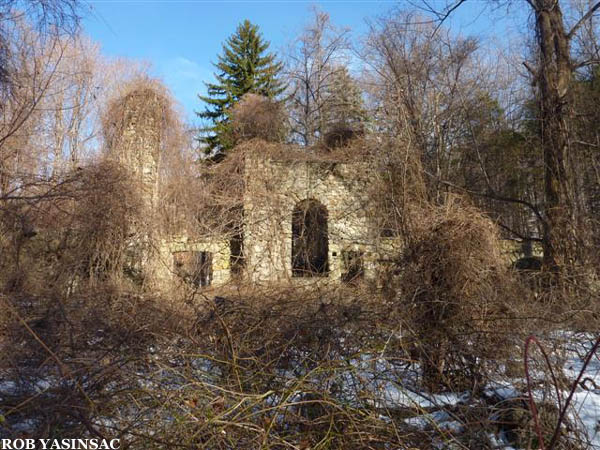
View of west facade of mansion. January 2010.
Northgate
(Stern / Cornish Estate)
COLD SPRING, N.Y.
View of west facade of mansion. January 2010.
UPDATE, SEPTEMBER 12, 2014:
Eagle Scout Chris Bohl reconstructed a gazebo at the Northgate ruins this
summer. Follow
this link to view historic and present-day images.
UPDATE, JUNE 3, 2014:
The Spring 2014 of the Hudson River Valley Review includes a new essay about the
Northgate estate in Cold Spring. The 11-page article, which I co-authored with
Thom Johnson and which borrows from a chapter in Hudson
Valley Ruins: Forgotten Landmarks of an American Landscape,
written by myself and Tom Rinaldi, shares new research about the development of
the estate along with previously-unpublished historic photographs. For more
information, please visit the following page: http://www.hudsonvalleyruins.org/rob/?p=1990.
UPDATE, APRIL 30, 2010:
I am very pleased to announce that historic photographs of the Cornish mansion
and estate have surfaced, ending years of mystery in the Hudson Valley for those
of us who wondered how the house and grounds appeared before falling to ruin.
Please follow
this link to see historic images of the Cornish mansion!
UPDATE, APRIL 2012:
I have been in touch with members of the Stern family and recently they informed
me of the existence of historic photographs that chronicle the construction and
early years of the Northgate estate. These photographs are currently being
scanned, and they will be presented in September 2012 during a lecture at the
Foundry School Museum in Cold Spring.
>>>>>>>>>>>>>>>>>>>>>>>>>>>>>>>>>>>>>>>>>>>>>>>>>>>>>>>>>>>>>>>>>>>>>>>>>>>>>>>
One of the great collections of
ruins in the Hudson Valley lies on publicly-accessible land in Putnam County. Although the layout
of property is well-known to hikers, the early history of the estate is nearly
unknown to historians. In 1917, Edward Joel Cornish and his wife Selina Bliss Carter Cornish acquired
650 acres (which they called Northgate) in Cold Spring from a New York City diamond merchant
named Sigmund Stern, who built the estate over the previous decade. In the early
1910s, Stern developed an elaborate estate with a mansion, garage, swimming pool, gardens and other outbuildings.
Just a few years after construction, and shortly after his first wife passed
away, Stern sold the estate to Edward and Selina Cornish, who summered there in
1916. The Cornish name is more often associated with this property, and hikers
know the area as the "Cornish estate ruins."
Edward Cornish (1861-1938) was President of
the National Lead Company from 1916 to 1933 and lived in New York to be near the
company offices. Cornish and his wife Selina,
formerly of Omaha, NB, died within two weeks of
each other in May of 1938. A year before his death, Edward Cornish, desiring to protect the estate in perpetuity
from the kinds of commercial industrial activities that were occurring at the
quarry on nearby Mt. Taurus, wished to donate his Cold Spring
property to New York State upon his death. State parks commissioners rejected
his offer, claiming the mountainous terrain was not suitable for a public park,
and that it was already protected by restrictions against quarrying.
Nephew Joel O'Donnell Cornish seems to have been the primary responsible party
for the Cornish heirs who owned the estate in the following decades. It is
believed that the estate was maintained through the 1950s, though perhaps not
occupied to the extant it was by the senior Cornishes. A fire in 1958 destroyed
most of the mansion; nearly all the woodwork that survived the fire has since
disintegrated. All that remains of the structures
on the estate are their stone walls.
When the Cornish heirs sold the estate in 1963 to Central Hudson Gas and
Electric, the property again became a focal point of conservation efforts. The regional utility giant briefly contemplated building a power plant on Breakneck Ridge, a fact
largely forgotten by historians as this plan was overshadowed by Con Ed's
prolonged and publicly-waged effort to build a similar plant across the Hudson
River at Storm King. By the end of the 1960s however, the ruins of Cornish
estate became part of the newly formed Hudson Highlands State Park and the plans
for the power plant was dropped by Central Hudson G & E. The legal battle by
conservation groups to preserve Storm King continued into the early 1980s.
In addition to the mansion, other surviving
structures include the swimming pool, the greenhouse, and the pump
house below to two picturesque waterfalls. At the north end of the 650-acre estate
stands a large stone cattle barn. Another large building, possibly a garage,
and another small farm building stand in ruins there as well. Even an old wagon rusts
away between the barn and the reservoir. Cornish raised
prized Jersey cows here and. newspaper articles of the 1920s chronicled the
record-setting milk producing efforts of Cornishes dairy cows, including one
named "Fon Owlet." (UPDATE: The reservoir disappeared when the
failing dam was destroyed by New York State Parks in late summer 2011.)
Further past the reservoir is Surprise Lake,
site of an old but still active summer camp. The Surprise
Lake Camp is closely
tied to the early history of Northgate. Sigmund Stern was active on the board of
the organization that operated the camp, and land transactions occurred between
Stern and the camp. The architecture of the main camp building is also similar
to the architecture of the Northgate mansion, and the two structures were built
just a few years apart. The Catskill Aqueduct also slices through the
Northgate property, separating the farm
parcel from the residential section, and an early
20th-century pump-house can be seen along that trail.
LINKS:
Marta
Dawes's website
has information about, and photographs of gravestones of, the Cornish family in
Omaha.
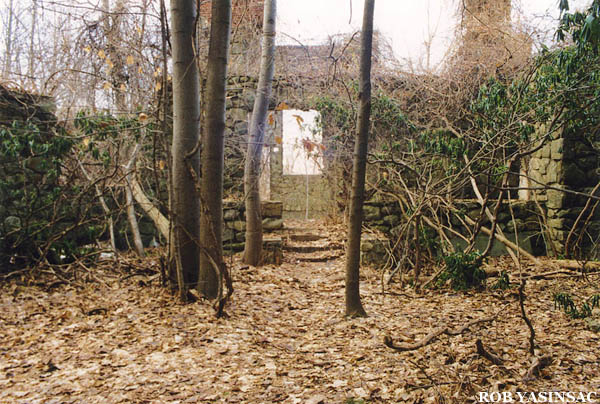
East courtyard entrance to Cornish mansion.
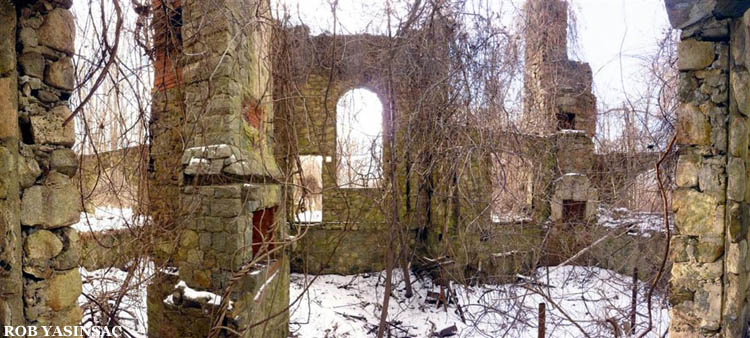
Mansion interior panorama,
looking west. January 2010.

Southwest corner of the mansion.
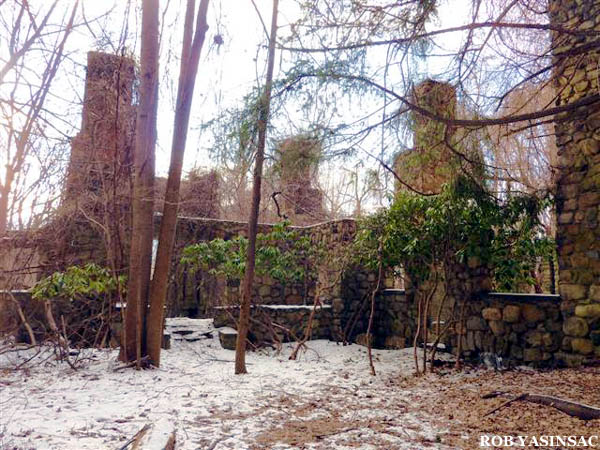
Mansion courtyard, looking northwest. January 2010.
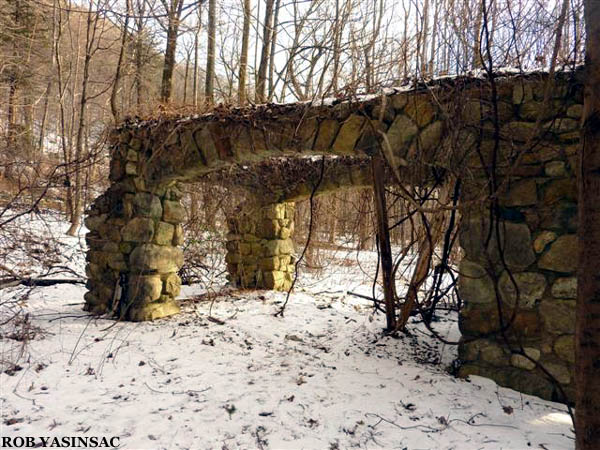
Mansion porte cochere. January 2010.
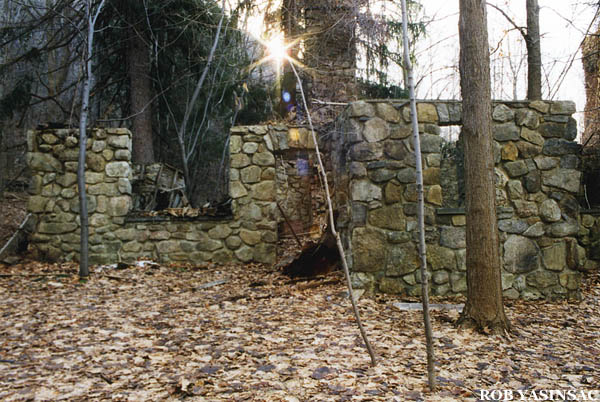
Winter solstice sun rising over Cornish mansion..
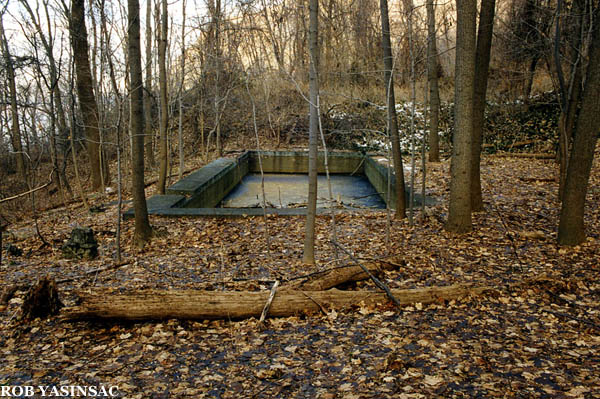
Swimming pool. Located just southwest of the
mansion,
fine views of Storm King could once be had from here.
This page copyright © 2010 by Robert J. Yasinsac.
Copying or reproducing text or photographs
without the permission of Robert Yasinsac is forbidden